What lies beneath: How benthic communities affect acoustic propagation – April 29, 2026
Many ocean areas contain a rich community of life in the sediments of the seafloor. Movement, burrowing, and other activities of organisms result in a seabed that is not uniform, as shown in the figure above. This variability can affect the acoustic properties of the sediments. Scientists are trying to better understand these benthic processes and how they affect the acoustic characteristics of the seabed.
Marine sediments are usually a mix of terrigenous material, clay, mud, and macro and microscopic shells or shell parts made of calcium carbonate or silicon dioxide. The sediment grain size, composition, and porosity are important factors in acoustic wave propagation, affecting parameters such as sound speed and attenuation (How does sound propagate through sediment?).

Within benthic communities, burrowing animals or animals building tubes out of shells and sediment create spaces that fill with seawater. Water supplies oxygen to the sediment, leading to changes in biogeochemical properties (molecules moving between living organisms and the physical environment). The animals, along with the structures they create, contribute to variability in geoacoustic properties of the substrate (sediment sound speed and attenuation, shear and interface wave propagation, and seabed acoustic scattering) (Yang and Jackson 2020; Jiang et al. 2023; Lee et al. 2016; Ballard et al. 2024; Chaytor et al. 2022; Dorgan et al. 2020; Lee et al. 2022; Knobles et al. 2025).
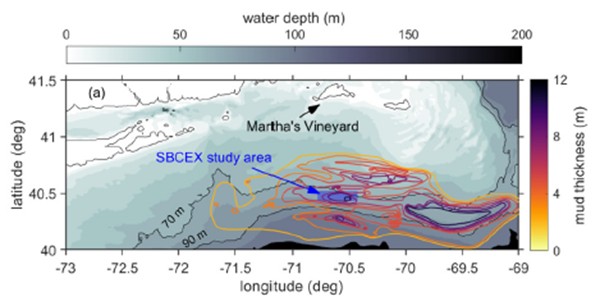
A research team funded by the U.S. Office of Naval Research conducted measurements to investigate the impact of benthic life on acoustic propagation. This research took place in the New England Mud Patch south of Martha’s Vineyard, Massachusetts, USA, a region representative of many similar areas around the world, shown in the figure below. Between April 16 – 20, 2022, the research team aboard the R/V Endeavor collected acoustic multicorer measurements at 14 locations, grouped into five sites (NE, Center, SEEP, SW, and SE), spread across the New England Mud Patch study area.
DOSITS_AcousticPropagation_Image2
Map of the SBCEX (Seabed Characterization) Study Area in the New England Mud Patch, south of Martha’s Vineyard, Massachusetts, USA. Image courtesy of Kevin Lee, reproduced from Lee et al. 2025 as published in The Journal of the Acoustical Society of America.
They found sediment particles in the study area ranging in size from 1 µm to 2 mm (Lee at al. 2025). The acoustic measurements and cores across all sample locations suggest that the presence and actions of benthic-dwelling creatures increase variability in surface sediment sound speed and attenuation. The scientists also found that organic matter reduces sediment stiffness, which is a controlling factor for sound speed and attenuation.
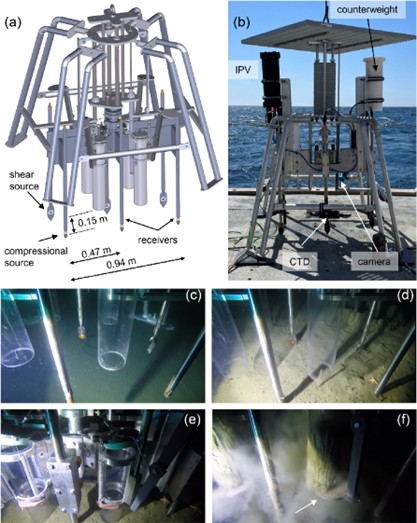
The multicorer is a platform that simultaneously measures sediment acoustic properties while collecting physical samples. A schematic (image a) and a photograph (image b) of an acoustic multicorer are shown below. As the multicorer descends through the ocean toward the seafloor (image c), the CTD collects a water-column sound speed profile. Once the multicorer contacts the seafloor, the acoustic probes (image d) and corer (image e) penetrate the seafloor and collect compressional and shear wave measurements in the sediment. The corer collects sediment samples (image f), and the attached camera records imagery of the deployment and seabed features. The sequence of events as the acoustic multicorer approaches the seafloor are shown in images C-F in the figure above.
DOSITS_AcousticPropagation_Image3
(a) Schematic of the acoustic multicorer showing probe and core layout and dimensions. (b) Photograph of the acoustic multicorer (without cores installed) showing the instrumentation pressure vessel (IPV) and auxiliary equipment, including a conductivity-temperature-depth (CTD) probe and camera. (c) Photograph of the acoustic multicorer approaching the seabed, (d) insertion of the acoustic probes into the seafloor, (e) full penetration of the probes and the cores, and (f) post-removal and core sample collection after the lower sample-retention doors are deployed (indicated in the photo by the arrow). Image courtesy of Kevin Lee, reproduced from Lee et al. 2025 as published in The Journal of the Acoustical Society of America.
Resources
Ballard, M.S. and Lee, K. M. 2017. The acoustics of marine sediments. Acoustics Today 13(3): 11-17 https://acousticstoday.org/the-acoustics-of-marine-sediments-by-megan-s-ballard-and-kevin-m-lee/
References
Ballard, M.S., Garcia, D.D., Lee, K.M., Venegas, G.R., McNeese, A.R., Wilson, P.S., and Chaytor, J.D.; Direct measurements of sediment geoacoustic properties in the New England Mud Patch and shelf break. J. Acoust. Soc. Am. 1 October 2024; 156 (4): 2889–2902. https://doi.org/10.1121/10.0032469
Chaytor, J.D. et al., “Measurements of Geologic Characteristics and Geophysical Properties of Sediments From the New England Mud Patch,” in IEEE Journal of Oceanic Engineering, vol. 47, no. 3, pp. 503-530, July 2022, doi: 10.1109/JOE.2021.3101013. https://ieeexplore.ieee.org/document/9543675
Dorgan, K.M., Ballentine, W., Lockridge, G., Kiskaddon, E., Ballard, M.S., Lee, K.M, Wilson, P.S. Impacts of simulated infaunal activities on acoustic wave propagation in marine sediments. J. Acoust. Soc. Am. 147: 812-823. https://doi.org/10.1121/10.0000558
Jiang, Y., Holland, C.W., Dosso, S.E., Dettmer, J; Depth and frequency dependence of geoacoustic properties on the New England Mud Patch from reflection coefficient inversion. J. Acoust. Soc. Am. 1 October 2023; 154 (4): 2383–2397. https://doi.org/10.1121/10.0021309
Knobles, D.P., Neilsen, T.B., Wilson, P.S., Becker, K.B. Introduction to the special issue on assessing sediment heterogeneity on continental shelves and slopes. J. Acoust. Soc. Am. 1 October 2025; 158 (4): 3078–3082. https://doi.org/10.1121/10.0039574
Lee, K.M., Ballard, M.S., Venegas, G.R., Wilson, P.S., Dorgan, K.M., Reed, A.H., Roosen, E.; Preliminary characterization of surficial sediment acoustic properties and infauna in the New England Mud Patch. Proc. Mtgs. Acoust. 23 May 2016; 26 (1): 070003. https://doi.org/10.1121/2.0000486
Lee, K.M., Venegas, G.R., Ballard, M.S., Dorgan, K.M., Kiskaddon E., McNeese, A.R., and Wilson, P.S.; Impacts of infauna, worm tubes, and shell hash on sediment acoustic variability and deviation from the viscous grain shearing model. J. Acoust. Soc. Am. 1 October 2022; 152 (4): 2456–2474. https://doi.org/10.1121/10.0014907
Lee, K.M, Dorgan, K.M., Venegas, G.R., Chaytor, J.D., Ballard, M.S., McNeese, A.R., and Wilson, P.S.; Investigation of surficial seabed heterogeneity and geoacoustic variability in the New England Mud Patch. J. Acoust. Soc. Am. 1 March 2025; 157 (3): 1686–1702. https://doi.org/10.1121/10.0036122Yang, J. and Jackson, D.R. “Measurement of Sound Speed in Fine-Grained Sediments During the Seabed Characterization Experiment,” in IEEE Journal of Oceanic Engineering, vol. 45, no. 1, pp. 39-50, Jan. 2020, doi: 10.1109/JOE.2019.2946004. https://ieeexplore.ieee.org/document/8894063