Acoustic Multicorer
An acoustic multicorer simultaneously measures acoustic properties of a sediment layer while collecting a physical sample of the sediment. This allows better modelling of acoustic propagation in seafloor sediments. An acoustic multicorer combines a traditional sediment coring apparatus with several sensors including acoustic probes, a camera, and conductivity-temperature-depth (CTD) sensors. A schematic (image a) and a photograph (image b) of an acoustic multicorer are shown below.
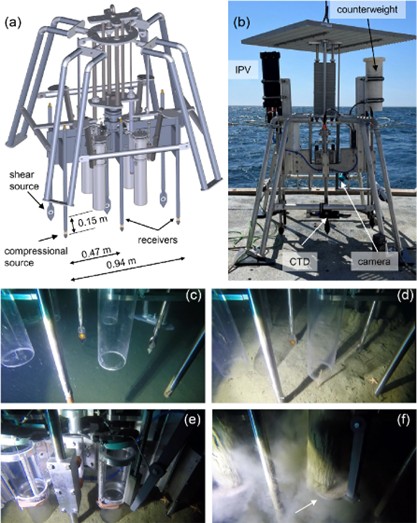
(a) Schematic of the acoustic multicorer showing probe and core layout and dimensions. (b) Photograph of the acoustic multicorer (without cores installed) showing the instrumentation pressure vessel (IPV) and auxiliary equipment, including a conductivity-temperature-depth (CTD) probe and camera. (c) Photograph of the acoustic multicorer approaching the seabed, (d) insertion of the acoustic probes into the seafloor, (e) full penetration of the probes and the cores, and (f) post-removal and core sample collection after the lower sample-retention doors are deployed (indicated in the photo by the arrow). Image courtesy of Kevin Lee, reproduced from Lee et al. 2025 as published in The Journal of the Acoustical Society of America.
Marine sediments play a critical role in the propagation of sound in shallow waters (less than or equal to 200 m), which include extensive regions on continental shelves. Direct measurements of seafloor sediment properties are important for understanding the geoacoustics properties of the seafloor (sediment sound speed and attenuation, shear and interface wave propagation, and seabed acoustic scattering).
As the multicorer descends through the ocean toward the seafloor (image c), the CTD collects a water-column sound speed profile. Once the multicorer contacts the seafloor, the acoustic probes (image d) and corer (image e) penetrate the seafloor and collect compressional and shear wave measurements in the sediment. The corer collects sediment samples (image f), and the attached camera records imagery of the deployment and seabed features. The sequence of events as the acoustic multicorer approaches the seafloor are shown in images C-F in the figure above.
The acoustic probes incorporate both a shear and a compressional source, as well as acoustic receivers. The geoacoustic properties of the sediment are estimated from the travel times and changes in signal amplitude between the sources and receivers.
Resources
Ballard, M.S. and Lee, K.M. 2017. The acoustics of marine sediments. Acoustics Today 13(3): 11-17 https://acousticstoday.org/the-acoustics-of-marine-sediments-by-megan-s-ballard-and-kevin-m-lee/
References
Lee, K.M, Dorgan, K.M., Venegas, G.R., Chaytor, J.D., Ballard, M.S., McNeese, A.R., and Wilson, P.S.; Investigation of surficial seabed heterogeneity and geoacoustic variability in the New England Mud Patch. J. Acoust. Soc. Am. 1 March 2025; 157 (3): 1686–1702. https://doi.org/10.1121/10.0036122