Marine invertebrate communication
How do marine invertebrates communicate using sound?
Some marine invertebrates, predominantly crustaceans, produce sounds that have been shown to facilitate social interactions, such as defense and courtship, and in one case, the acoustic advertisement of a parasite removal opportunity to passing fish. Scientists have given these acoustic emissions a variety of human-auditory biased descriptors such as rumbles, buzzes, honks, raps, drums and clicks to describe them to other humans, but to invertebrates they are acoustic signals that convey critical meaning crucial to surviving in their environments. See the marine invertebrate audio gallery to play audio of these sounds, accompanied visually by frequency spectrograms.
Members of the spiny lobster family Palinuridae produce sound as a defense mechanism. The lobsters generate stridulatory sounds via their plectrum and file when the antennae are moved[1]Patek, S. N. (2001). Spiny lobsters stick and slip to make sound. Nature, 411(6834), 153–154. https://doi.org/10.1038/35075656. (see How do marine invertebrates produce sound?). Research conducted with European spiny lobsters in aquariums showed defensive posturing and clicking sounds produced by the spiny lobster in response to predatory behavior by the gray triggerfish[2]Staaterman, Patek, & Claverie. (2010). Disentangling defense: the function of spiny lobster sounds. Behaviour, 147(2), 235–258. https://doi.org/10.1163/000579509X12523919243428. Caribbean spiny lobsters that produced rasp sounds were better able to escape predatory octopus attacks and resist attacks for a longer duration than silent lobsters[3]Bouwma, P. E., & Herrnkind, W. F. (2009). Sound production in Caribbean spiny lobster Panulirus argus and its role in escape during predatory attack by Octopus briareus. New Zealand Journal of Marine and Freshwater Research, 43(1), 3–13. https://doi.org/10.1080/00288330909509977.
Semi-terrestrial crabs, such as fiddler crabs and ghost crabs, produce sounds that are transmitted through the air and the sand or mud substrate (see How do marine invertebrates produce sound?). These crabs sense substrate vibration through mechanoreceptors and some species can sense air-borne sound through pressure-sensitive membranes. (see How do marine invertebrates detect sound?).
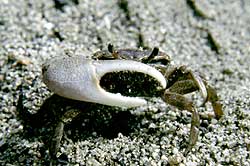
A fiddler crab uses its cheliped to produce sound to attract females as well as deter predators and other male competitors. Photo courtesy of Jerry Prezioso.
Male fiddler crabs and ghost crabs (see audio gallery) are known to use a combination of visual and auditory or vibrational signalling behaviours in their social interactions – for both courtship displays and burrow territorial defense. They produce rapping or honking sounds as one way to court females for reproduction[4]Salmon, M. (1983). Acoustic “calling” by fiddler and ghost crabs. In Papers from the Conference on the Biology and Evolution of Crustacea. Australian Museum Memoir 18 (pp. 63–76). Sydney, New South Wales, Australia: Australian Museum. https://media.australian.museum/media/Uploads/Journals/17629/372_complete.pdf#:~:text=This%20paper%20reviews%20what%20has,detection%20abilities%20and%20the%20behavioural
[5]Clayton, D. (2008). Singing and dancing in the ghost crab Ocypode platytarsus (Crustacea, Decapoda, Ocypodidae). Journal of Natural History, 42(3–4), 141–155. https://doi.org/10.1080/00222930701840530. During the day, male fiddler crabs will wave with their enlarged claw to attract females to their burrow. Once a female crab approaches, the male switches to sound production from within or just outside of his burrow. To produce sound, the male crabs will strike the substrate with the lower base of their enlarged claw, drum on the substrate with both claws, and/or tap the ground with their walking legs. Sound production can last several minutes.
Scientists have further observed that male crabs “pay attention” to neighboring males that are drumming or rapping. If one male begins to produce sound vigorously, other males may respond by also increasing the speed and loudness of their sound production. Additionally, if one male is silent and a neighboring male begins to produce sound vigorously, the previously silent male will often join in. Male crabs will also alter their rapping rate to avoid overlap with other males. A male crab that avoids overlap between his raps and that of a neighboring male will present a distinct signal that can be better detected by a receptive female. Some species of fiddler crab produce sound lasting up to several hours by rapping outside their burrows.
Although semi-terrestrial crabs produce sound primarily for courtship, they also can send warning signals to alert other crabs to the presence of a nearby predator and use sound during agonistic interactions with other male crabs (for example mangrove crabs[6]Boon, P., Yeo, D., & Todd, P. (2009). Sound production and reception in mangrove crabs Perisesarma spp. (Brachyura: Sesarmidae). Aquatic Biology, 5, 107–116. https://doi.org/10.3354/ab00136).
Cleaner shrimps identify themselves as a “cleaner” and advertise their services to reef fish by clapping their claws (chelipeds). The hungrier the shrimp, the more clapping it does. In this video, one can watch a cleaner shrimp (small, transparent animal at center) clap/signal to reef fish swimming nearby.
Video by Lucille Chapuis, University of Western Australia.
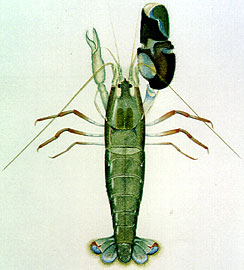
The snapping shrimp, Alpheus heterochaelis. Courtesy of Department of Applied Physics, University of Twente.
Some marine invertebrates communicate with sound for purposes other than defense and courtship. Cleaner shrimp feed on parasites found on the skin, and in the mouths and gills of reef fish. The cleaner shrimp typically establishes ‘cleaning stations’ on a coral reef. Fish identify cleaner shrimp based on their cleaning station and visual displays, and some shrimp will also provide acoustic signals by clapping their claws when reef fish approach. Clapping also has been observed to occur in the presence of predators; shrimp were shown to clap more often when predatory fish approached[7]Chapuis, L., & Bshary, R. (2010). Signalling by the cleaner shrimp Periclimenes longicarpus. Animal Behaviour, 79(3), 645–647. https://doi.org/10.1016/j.anbehav.2009.12.012.
Snapping shrimp, or pistol shrimp, produce one of the most intense biotic underwater sound pressure levels ever recorded[8]Jakobsen, L., Christensen-Dalsgaard, J., Juhl, P. M., & Elemans, C. P. H. (2021). How loud can you go? Physical and physiological constraints to producing high sound pressures in animal vocalizations. Frontiers in Ecology and Evolution, 9, 657254. https://doi.org/10.3389/fevo.2021.657254 with the rapid closure of their claws producing a cavitation bubble that collapses to produce a loud snap[9]Versluis, M., Schmitz, B., Von Der Heydt, A., & Lohsea, D. (2000). How Snapping Shrimp Snap: Through Cavitating Bubbles. Science. 289, 2114-2117(2000). https://doi.org/10.1126/science.289.5487.2114, with which they stun their prey and ward off predators. (see How do marine invertebrates produce sound?). When recorded at the environmental level, snapping shrimp populations are responsible for the majority of sounds produced in many nearshore environments (including but not limited to bays, harbors, oyster reefs, coral reefs, estuaries, mangroves).
Video: On the Sound of Snapping Shrimp
(created by scientific authors Veslius et al., 2000[10]Versluis, M., Schmitz, B., Von Der Heydt, A., & Lohsea, D. (2000). How Snapping Shrimp Snap: Through Cavitating Bubbles. Science. 289, 2114-2117(2000). https://doi.org/10.1126/science.289.5487.2114)
At the environmental level, snapping shrimp sound production is known to vary by time of day, tidal and lunar cycle and season. Snapping shrimp noise levels measured at nighttime were higher than those during the day by 3–6 dB[11]Johnson, M. W., Everest, F. A., and Young, R. W. (1947). The role of snapping shrimp (Crangon and Synalpheus) in the production of underwater noise in the sea. Biol. Bull. 93, 122–138. doi: https://doi.org/10.2307/1538284 [12]Everest, F. A., Young, R. W., and Johnson, M. W. (1948). Acoustical characteristics of noise produced by snapping shrimp. J. Acoust. Soc Am. 20, 137–142. doi: https://doi.org/10.1121/1.1906355[13]Lammers, M. O., Brainard, R. E., Au, W. W. L., Mooney, T. A., and Wong, K. B. (2008). An ecological acoustic recorder (EAR) for long-term monitoring of biological and anthropogenic sounds on coral reefs and other marine habitats. J. Acoust. Soc Am. 123, 1720–1728. doi: https://doi.org/10.1121/1.2836780, with increased snapping rates in a given area at sunrise and sunset. This acoustically active period is commonly referred to as a dawn and dusk “chorus” – when many crustaceans and fish are acoustically active. One study showed that the number of snaps correlated with seasons [14]Bohnenstiehl, D. R., Lillis, A., & Eggleston, D. B. (2016). The curious acoustic behavior of estuarine snapping shrimp: Temporal patterns of snapping shrimp sound in sub-tidal Oyster Reef Habitat. PLOS ONE, 11(1). https://doi.org/10.1371/journal.pone.0143691. Other studies show that snapping rates can be correlated with tidal patterns [15]Song, Z., Ou, W., Su, Y., Li, H., Fan, W., Sun, S., Wang, T., Xu, X., & Zhang, Y. (2023). Sounds of snapping shrimp (Alpheidae) as important input to the soundscape in the southeast China Coastal Sea. Frontiers in Marine Science, 10. https://doi.org/10.3389/fmars.2023.1029003, and vary with diel and lunar cycles, as well as with temperature and light levels[16]Lillis, A., & Mooney, T. A. (2018). Snapping shrimp sound production patterns on Caribbean coral reefs: Relationships with celestial cycles and environmental variables. Coral Reefs, 37(2), 597–607. https://doi.org/10.1007/s00338-018-1684-z.
Even with advanced knowledge of the mechanisms of snapping shrimp sound production and population acoustics over space and time, there is still much to learn about how snapping shrimp are acoustically interacting with each other and with other animals in their specific environments. For instance, scientists studying sponge-dwelling snapping shrimp observed ‘coordinated snapping’ behaviors among related conspecifics that successfully repelled invading shrimp[17]Tóth, E. & Duffy, J.E. (2005). Coordinated group response to nest intruders in social shrimp. Biol. Lett.149–52 http://doi.org/10.1098/rsbl.2004.0237 – a report of a collective group response. This study provides a glimpse into what targeted future research in individual-to-population level behaviors may reveal about how snapping shrimp, in all their various habitats and climes, use acoustics in their daily lives.
Additional Links on DOSITS
- Animals and Sound > How do marine invertebrates detect sounds?
- Animals and Sound > How do marine invertebrates produce sounds?
- Audio Gallery > Snapping Shrimp
- Audio Gallery > Spiny Lobster
- Audio Gallery > Ghost Crab
Additional Resources
- Sebeok, T., ed, 1977, “How Animals Communicate.” Indian University Press, Bloomington, 305-307.
- Mooney, T.A., Roberts, L., McCravy, K.W., & Thomas, J.A. (2025). Invertebrates Other than Insects. In: Erbe, C., Thomas, J.A. (eds) Exploring Animal Behavior Through Sound: Volume 2. Springer, Cham. https://doi.org/10.1007/978-3-031-83460-8_1
Cited References
| ⇡1 | Patek, S. N. (2001). Spiny lobsters stick and slip to make sound. Nature, 411(6834), 153–154. https://doi.org/10.1038/35075656 |
|---|---|
| ⇡2 | Staaterman, Patek, & Claverie. (2010). Disentangling defense: the function of spiny lobster sounds. Behaviour, 147(2), 235–258. https://doi.org/10.1163/000579509X12523919243428 |
| ⇡3 | Bouwma, P. E., & Herrnkind, W. F. (2009). Sound production in Caribbean spiny lobster Panulirus argus and its role in escape during predatory attack by Octopus briareus. New Zealand Journal of Marine and Freshwater Research, 43(1), 3–13. https://doi.org/10.1080/00288330909509977 |
| ⇡4 | Salmon, M. (1983). Acoustic “calling” by fiddler and ghost crabs. In Papers from the Conference on the Biology and Evolution of Crustacea. Australian Museum Memoir 18 (pp. 63–76). Sydney, New South Wales, Australia: Australian Museum. https://media.australian.museum/media/Uploads/Journals/17629/372_complete.pdf#:~:text=This%20paper%20reviews%20what%20has,detection%20abilities%20and%20the%20behavioural |
| ⇡5 | Clayton, D. (2008). Singing and dancing in the ghost crab Ocypode platytarsus (Crustacea, Decapoda, Ocypodidae). Journal of Natural History, 42(3–4), 141–155. https://doi.org/10.1080/00222930701840530 |
| ⇡6 | Boon, P., Yeo, D., & Todd, P. (2009). Sound production and reception in mangrove crabs Perisesarma spp. (Brachyura: Sesarmidae). Aquatic Biology, 5, 107–116. https://doi.org/10.3354/ab00136 |
| ⇡7 | Chapuis, L., & Bshary, R. (2010). Signalling by the cleaner shrimp Periclimenes longicarpus. Animal Behaviour, 79(3), 645–647. https://doi.org/10.1016/j.anbehav.2009.12.012 |
| ⇡8 | Jakobsen, L., Christensen-Dalsgaard, J., Juhl, P. M., & Elemans, C. P. H. (2021). How loud can you go? Physical and physiological constraints to producing high sound pressures in animal vocalizations. Frontiers in Ecology and Evolution, 9, 657254. https://doi.org/10.3389/fevo.2021.657254 |
| ⇡9, ⇡10 | Versluis, M., Schmitz, B., Von Der Heydt, A., & Lohsea, D. (2000). How Snapping Shrimp Snap: Through Cavitating Bubbles. Science. 289, 2114-2117(2000). https://doi.org/10.1126/science.289.5487.2114 |
| ⇡11 | Johnson, M. W., Everest, F. A., and Young, R. W. (1947). The role of snapping shrimp (Crangon and Synalpheus) in the production of underwater noise in the sea. Biol. Bull. 93, 122–138. doi: https://doi.org/10.2307/1538284 |
| ⇡12 | Everest, F. A., Young, R. W., and Johnson, M. W. (1948). Acoustical characteristics of noise produced by snapping shrimp. J. Acoust. Soc Am. 20, 137–142. doi: https://doi.org/10.1121/1.1906355 |
| ⇡13 | Lammers, M. O., Brainard, R. E., Au, W. W. L., Mooney, T. A., and Wong, K. B. (2008). An ecological acoustic recorder (EAR) for long-term monitoring of biological and anthropogenic sounds on coral reefs and other marine habitats. J. Acoust. Soc Am. 123, 1720–1728. doi: https://doi.org/10.1121/1.2836780 |
| ⇡14 | Bohnenstiehl, D. R., Lillis, A., & Eggleston, D. B. (2016). The curious acoustic behavior of estuarine snapping shrimp: Temporal patterns of snapping shrimp sound in sub-tidal Oyster Reef Habitat. PLOS ONE, 11(1). https://doi.org/10.1371/journal.pone.0143691 |
| ⇡15 | Song, Z., Ou, W., Su, Y., Li, H., Fan, W., Sun, S., Wang, T., Xu, X., & Zhang, Y. (2023). Sounds of snapping shrimp (Alpheidae) as important input to the soundscape in the southeast China Coastal Sea. Frontiers in Marine Science, 10. https://doi.org/10.3389/fmars.2023.1029003 |
| ⇡16 | Lillis, A., & Mooney, T. A. (2018). Snapping shrimp sound production patterns on Caribbean coral reefs: Relationships with celestial cycles and environmental variables. Coral Reefs, 37(2), 597–607. https://doi.org/10.1007/s00338-018-1684-z |
| ⇡17 | Tóth, E. & Duffy, J.E. (2005). Coordinated group response to nest intruders in social shrimp. Biol. Lett.149–52 http://doi.org/10.1098/rsbl.2004.0237 |