Brown Mussel
Sounds of Brown Mussels (Perna perna)
Description
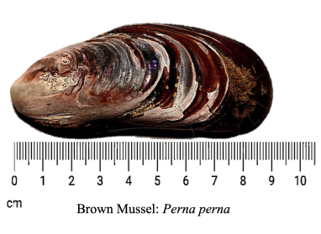
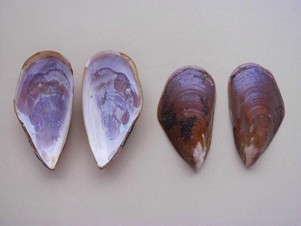
Perna perna, commonly known as the Brown Mussel, or the Mexilhao mussel, was originally found in Africa and South America, where it is an important aquaculture species, but is has established itself as an invasive species in North American waters since it entered the Gulf of Mexico in ship ballast water. This warm water mussel has smooth outer shells which are brown in color with concentric growth lines (see figure below), purple interior valves, and can vary in size from 90-120 mm. Like other marine mussels, the brown mussel is a filter-feeding, sessile bivalve that attaches to external structures using byssal threads. Marine mussels are intertidal organisms, so they have adapted to withstand extreme temperature and salinity changes, periods without submersion during low tides, intense wave turbulence, and strong currents. These rapidly growing mussels can be formidable biofoulers to manmade marine objects and attach in great densities to hard surfaces such as navigation buoys, ship intake ports, jetties, oil platforms, wrecks, and rocky shores. (For more on general mussel biology and behavior, see Ref 1.)
BrownMussel_Img1
Typical length of a Brown Mussel valve (used with permission from Prof. Ubirajara Gonçalves de Melo Júnior).
BrownMussel_Img2
Inner and outer valves of the Brown Mussel (Perna perna (Linnaeus, 1758), with the internal soft-bodied organism removed. Credit: https://commons.wikimedia.org/wiki/File:Perna_perna_(Linnaeus,_1758)_2013_001.JPG Attribution: Veronidae, CC BY-SA 3.0 https://creativecommons.org/licenses/by-sa/3.0, via Wikimedia Commons
Brown mussels generate sounds by rapidly closing their shells (valves) using internal musculature and expelling jets of water (Ref 2). Recordings show two distinct, short duration impulse sounds: 1) “cough” (longer duration) and 2) “snap” (shorter duration, either single or sequential). The mussel “cough” may be similar to scallop “coughs” (Ref 3), whereas the mussel “snap” recording appears to relate to variations in the intensity of the valve movements. See the figure below for acoustic comparison of these distinct sounds which range in frequency from 0.1-24 kHz, with the majority of sounds concentrated between 4-6 kHz. The intensity of the sounds produced by the individual brown mussel is low (maximum sound pressure levels ranged between 43 to 105 dB re 1 µPa). However, when groups of mussels (groups of individuals: 10, 40 and 80) were measured in laboratory aquaria, the recorded acoustic levels increased with size of group, leading the authors to conclude that the acoustic activity rate of this mussel species should be considered density-dependent (Ref 2).
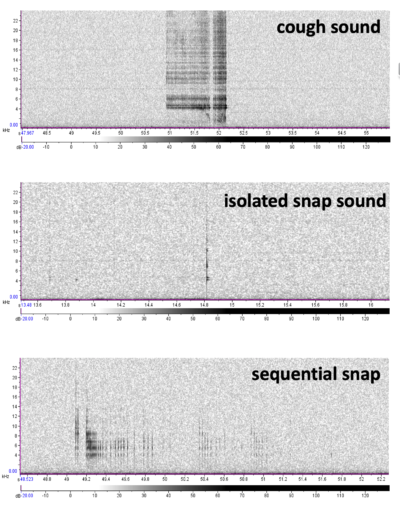
The “Coughing” and “snap” sounds are generated by the water flow turbulence created by the abrupt closure of the mussel valves of a single Brown Mussel (Perna perna) recorded under controlled laboratory conditions (Ref 2). Because these sounds are so short in duration and are relatively quiet (to human ears), we have opted to provide them in a repeated sequence (3 times), but this is for auditory educational purposes only, and does not indicate that individual mussels repeated in this pattern during the experiment. For the case of the isolated snap sound, we have also modified the volume to 25dB and applied a noise reduction of 20dB for the viewers to hear and listen more properly
References
- Silva dos Santos, F., Neves, R.A.F., Crapez, M.A.C., Teixeira, V.L. and Krepsky, N. (2022). How does the brown mussel Perna perna respond to environmental pollution? A review on pollution biomarkers. Journal of Environmental Sciences, [online] 111, pp.412–428. doi: https://doi.org/10.1016/j.jes.2021.04.006.
- Júnior, U., Xavier, F., Campbell, D., Silveira, N., Versiani, L., Cumplido, R., Rodrigues, M. and Netto, E. (2019). Characterization of the acoustic activity of Perna perna (bivalve mollusc) under laboratory conditions. Proceedings of Meetings on Acoustics, [online] 37, p.010010. doi: https://doi.org/10.1121/2.0001254.
- Di Iorio, L., Gervaise, C., Jaud, V., Robson, A. A., & Chauvaud, L. (2012). Hydrophone detects cracking sounds: Non-intrusive monitoring of bivalve movement. Journal of Experimental Marine Biology and Ecology, 432–433, 9–16. https://doi.org/10.1016/j.jembe.2012.07.010.