Franciscana
Franciscana (Pontoporia blainvillei)
Description
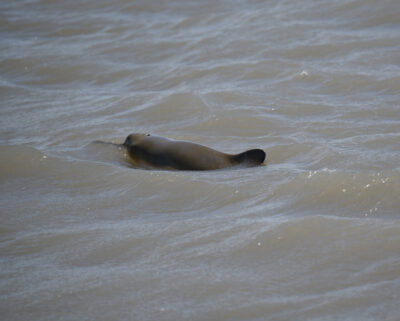
The franciscana is a small river dolphin with a plump body, low dorsal fin, and distinctly long and slender beak (it is 15% of the animal’s total body length). Limited data show the species to produce whistles, burst pulsed sounds, and echolocation clicks. Photo credit: Miguel Iñíguez, WDC, Whale and Dolphin Conservation.
Franciscana dolphins are small cetaceans. They can reach a body length up to 1.8 m (6 ft) and weighs up to 40 kg (90 lb). They are endemic to the saltwater estuaries and shallow (up to 50 m), coastal waters of Brazil, Uruguay, and Argentina. They forage on fishes, squid, and shrimp.
Franciscanas do not migrate. There is substantial overlap between the regions they are found and local fisheries. Because of the high levels of fisheries bycatch, coupled with their restricted distributions, limited reproductive cycle, and short lifespan, the fransicana are considered and endangered species. They are classified as “vulnerable” by the International Union for Conservation of Nature (IUCN). “Seal safe” pingers are being explored as a potential tool to reduce fisheries bycatch.
Due to its small size, color, and elusive behavior, franciscanas are a challenge to study visually. Given that franciscana dolphins produce whistles, burst pulses, and echolocation clicks, passive acoustic monitoring has become an important tool for studying the species’ behavior and habitat use.
Franciscana whistles are acoustically complex and vary in fundamental frequency from 0.7 to 94.5 kHz. They can last from 0.008 to 0.361 s in duration and may be ascending or descending in pattern, with many inflections, or remain at a constant frequency.
Recordings of burst pulsed sounds contain approximately 24-81 clicks produced with an inter-click interval of about 10 ms . The calls last anywhere from 75 to150 ms.They also vary in peak frequency from 41 to 99 kHz. (Cremer et al. 2017, Tellechea et al. 2017).
Burst pulsed sounds, as well as whistles, have primarily been recorded in groups of franciscana that contain calves. This indicates the signals may be important in mother-calf communication. This is supported by studies with newly born franciscana in captivity. Scientists found the dolphins to be acoustically active at a very young age, producing burst pulsed sounds and echolocation clicks one week after birth.
Franciscana echolocation signals have been detected during both day and night. These clicks are narrow band, high frequency signals that range from 130 to 149 kHz with a peak frequency of 139 kHz. The signals consist of sequences with a mean duration of approximately 670 ms and have a mean inter-click interval of 30 ms.
Additional Links on DOSITS
- Animals and Sound > Use of Sound > Marine Mammal Communication
- Animals and Sound > Advanced > Specialized sounds in cetacean communication
- People and Sound > How is sound used to protect marine mammals?
- DOSITS Webinar archive > Overview of Passive Acoustic Monitoring
Additional Resources
- American Cetacean Society Fact Sheet: Franciscana.
- Whale and Dolphin Conservation Society: Franciscana.
References
- Barcellos, D. D., & De O. Santos, M. C. (2021). Echolocation characteristics of franciscana dolphins ( Pontoporia blainvillei ). Marine Mammal Science, 37(3), 1139–1149. https://doi.org/10.1111/mms.12796
- Cremer, M. J., Holz, A. C., Bordino, P., Wells, R. S., & Simões-Lopes, P. C. (2017). Social sounds produced by franciscana dolphins, Pontoporia blainvillei (Cetartiodactyla, Pontoporiidae). The Journal of the Acoustical Society of America, 141(3), 2047–2054. https://doi.org/10.1121/1.4978437
- Cremer, M. J., Danilewicz, D., Sucunza, F., Berninsone, L. G., Paitach, R. L., & Wells, R. S. (2022). Behavior and movement patterns of franciscana dolphins. In The Franciscana Dolphin (pp. 149–174). Elsevier. https://doi.org/10.1016/B978-0-323-90974-7.00014-8
- Crespo, E. A. (2018). Franciscana Dolphin. In Encyclopedia of Marine Mammals (pp. 388–392). Elsevier. https://doi.org/10.1016/B978-0-12-804327-1.00133-3
- Melcón, M. L., Failla, M., & Iñíguez, M. A. (2012). Echolocation behavior of franciscana dolphins ( Pontoporia blainvillei ) in the wild. The Journal of the Acoustical Society of America, 131(6), EL448–EL453. https://doi.org/10.1121/1.4710837