Ghost crab (Ocypode spp.)
Ghost Crab: Gut growls and Claw raps
Gastric Mill Stridulation
A laboratory recording of a ghost crab lunging and then emitting growling sounds (from the gastric mill) when presented with a model of another crab entering their tank. See video for corresponding visual displays (lunging and claw waving) that accompany the emission of sounds from the ghost crab. Used with permission from Taylor et al. 2019.
Ghost Crab “Rapping”
Ghost crab, Ocypodej ousseaumei, producing rapping sounds. Sounds were recording by inserting a small microphone into the substrate near crab burrows. Used with permission from David Clayton, Sultan Qaboos University (Oman).
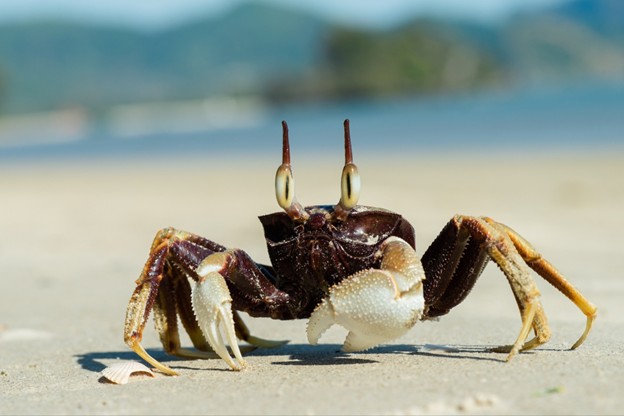
Ocypode ceratophthalma (horned ghost crab) Krabi / Thailand. Photo by Thai National Parks Wikipedia CC BY-SA 3.0
Description
Ghost crabs, Ocypode spp., which live in the intertidal zones of tropical and temperate sandy beaches globally, may use a variety of acoustics methods for territorial defense and courtship displays. One method of marine invertebrate sound production commonly found in crustaceans involves stridulation, which is the rubbing together of two rigid body parts (e.g., antennae, legs, claws). Most crustaceans stridulate by rubbing their legs or claws on external ridges of their carapaces.
Some ghost crabs also use gastric stridulation, also called foregut “growling,” during agonistic interactions with other crabs. Growling sounds are produced by rubbing together internal comb-like teeth in their digestive foreguts (gastric mill) to produce sounds with dominant frequencies below 2 kHz (Audio 1). Researchers hypothesize that this internal sound-producing structure allows ghost crabs to produce sounds during aggressive interactions, in addition to using claws for visual displays or aggressive attacks (Ref 1).
Male ghost crabs also produce sounds by percussion, which is achieved by rapping or drumming major chelipads (a larger claw) or another body part against the substrate (e.g., hitting the ground with one or both of their claws: Audio 2. (Ref 2–Ref 3). A comparison of four different species of ghost crabs rapping one or both chelipeds “suggest the existence of species specific differences, predominantly in the temporal properties of rapping and in the physical structure of stridulation.” (Ref 4). Research suggests that rapping is most likely a signal to advertise the location of crab residents (in burrows), while stridulation is used for burrow defence.
While claws can be used in visual displays, rapid stepping during these visual dance displays also produces auditory/vibrational sound that is distinct from that produced by the cheliped rapping, making this another form of acoustic communication used by these versatile semi-terrestrial crabs (Ref 2 and Ref 5).
Video of aggressive ghost crab lunging and rasping, with corresponding spectrogram. Growling from the gut: co-option of the gastric mill for acoustic communication in ghost crabs. Proceedings of the Royal Society B: Biological Sciences, [online] 286(1910), p.20191161. doi:https://doi.org/10.1098/rspb.2019.1161.
Resources:
DOSITS: How do marine invertebrates produce sound?
References
- Taylor, J., deVries, M.S. and Elias, D.O. (2019). Growling from the gut: cooption of the gastric mill for acoustic communication in ghost crabs. Proceedings of the Royal Society B: Biological Sciences, 286(1910), p.20191161. doi: https://doi.org/10.1098/rspb.2019.1161.
- Clayton, D. (2008). Singing and dancing in the ghost crab Ocypode platytarsus (Crustacea, Decapoda, Ocypodidae). Journal of Natural History, [online] 42(34), pp.141–155. doi:https://doi.org/10.1080/00222930701840530.
- Imafuku, M., Habu, E., & Nakajima, H. (2001). Analysis of waving and sound‐production display in the ghost crab, Ocypode stimpsoni. Marine and Freshwater Behaviour and Physiology, 34(4), 197–211. https://doi.org/10.1080/10236240109379074
- Clayton, D. (2001). Acoustic calling in four species of ghost crabs: Ocypode jousseaumei, O. platytarsus, O. rotunda and O. saratan (Brachyura: Ocypodidae). Bioacoustics, 12(1), 37–55. https://doi.org/10.1080/09524622.2001.9753477
- Clayton, D. (2005). Substrate (acoustic/vibrational) communication and ecology of the ghost crab Ocypode jousseaumei (Brachyura: Ocypodidae). Marine and Freshwater Behaviour and Physiology, 38(1), 53–70. https://doi.org/10.1080/10236240500057952