Webinar Archive: Acoustic Sensing on Autonomous Underwater Platforms
Acoustic Sensing on Autonomous Underwater Platforms Overview
Please join us for a discussion of the use of autonomous underwater technologies for acoustic sensing of marine mammals.
Acoustic Sensing on Autonomous Underwater Platforms – October 14, 2026
Dr. Lora Van Uffelen, Associate Professor, University of Rhode Island
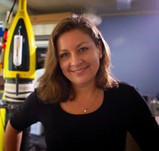
Lora Van Uffelen is an Associate Professor in the Department of Ocean Engineering at the University of Rhode Island, with a joint appointment in the Graduate School of Oceanography. She earned her Ph.D. in Oceanography from the Scripps Institution of Oceanography at the University of California San Diego. Dr. Van Uffelen’s research focuses broadly on acoustic propagation and the influence of oceanographic variability, with recent work centered on sound propagation in the Arctic. She leads the OPERA Lab (Ocean Platforms, Experiments, and Research in Acoustics), where she is particularly interested in acoustic receiving using mobile platforms and the use of long-range acoustic signals for underwater positioning. In addition to mentoring graduate students, she teaches both undergraduate and graduate courses in underwater acoustics and ocean engineering.
Dr. Selene Fregosi, Assistant Professor, Senior Research, Marine Mammal Institute, Oregon State University
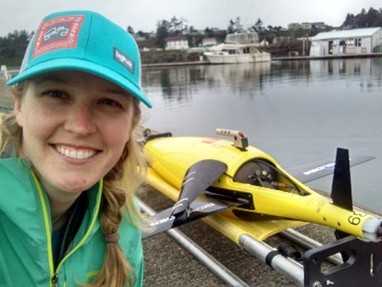
Selene Fregosi is an Assistant Professor at the Marine Mammal Institute at Oregon State University, an affiliate with the NOAA Fisheries Pacific Islands Fisheries Science Center, and an Associate Scientist at Southall Environmental Associates, Inc. She is a bioacoustician whose research uses passive acoustic monitoring to understand marine mammal distribution, estimate populations, and examine behavior and responses to ocean noise. Dr. Fregosi’s primary research platforms are autonomous mobile systems such as underwater gliders and drifters—although she will happily search for whale calls in just about any recording that lands on her desk.
Dr. David Mellinger, Professor, Senior Research, Cooperative Inst. for Marine Ecosystems and Resources Studies, Oregon State University
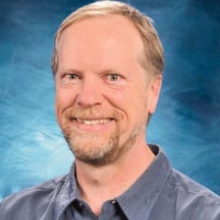
Dr. Mellinger has worked in acoustic signal processing since 1987 and on acoustic detection, classification, and localization of marine mammals since 1992. He has developed a variety of new methods in these fields, and has implemented these and many other existing methods in several software packages. The most popular of these packages, Ishmael, is in use worldwide by hundreds of researchers studying vocalization, distribution, and behavior of marine mammals. He has also led and participated in many passive acoustic field research projects to detect, classify, and locate marine mammals in the Atlantic, Pacific, Arctic, Indian, and Southern Oceans. These projects have employed a variety of passive-acoustic technologies, including fixed moored hydrophones, cabled hydrophone arrays, quasi-fixed real-time hydrophones, and drifting sonobuoys, and have covered many species of marine mammals. He has chaired conferences and workshops since 2002 on passive acoustic monitoring for assessing of the state of the technologies and methods, on animal acoustic communication and behavior, on automated detection, classification, and localization, and density estimation of marine mammals using passive acoustics, and on using detection methods for understanding marine mammal distributions. Since 2008 he has used gliders for passive acoustic monitoring of cetaceans, using them on dozens of glider deployments in the western Atlantic, the northern Gulf of Mexico, and the Pacific off the West Coast, in Alaska, in Hawaii, and in the Mariana Islands.